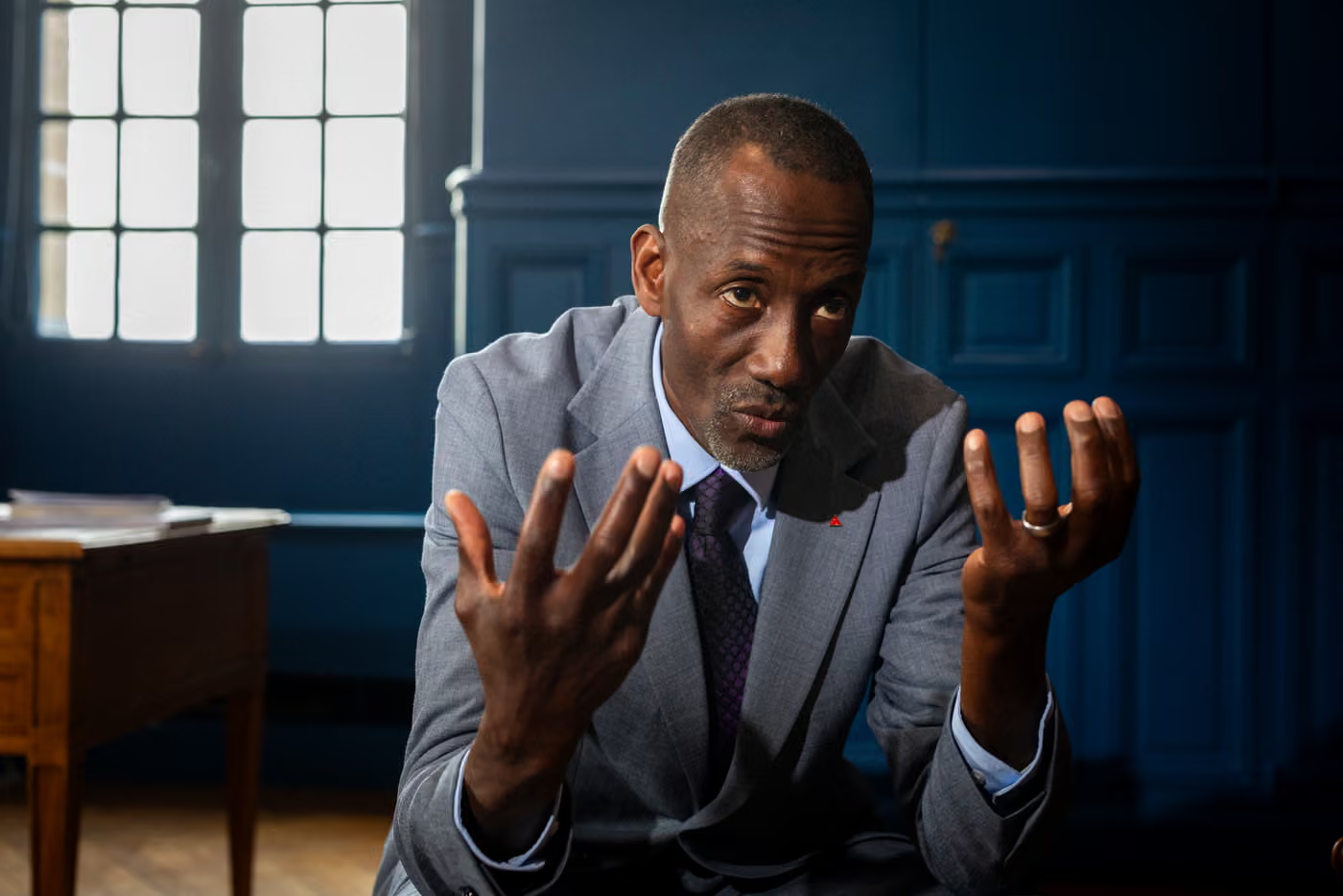
Saint-Denis is just over 9km from the centre of Paris but is in the poorest department in metropolitan France, a region marked by unemployment, low incomes and social disadvantage. But its town hall hosted joyous celebrations on 15 March. Bally Bagayoko who led a leftwing list pulled off a remarkable feat, decisively winning the second biggest city in the Paris region in the first of two rounds.
For the first time, Saint-Denis, which is home to 130 nationalities, has a mayor who reflects its community – a child of the city and the son of Malian immigrants.
Other municipalities around Paris have also elected mayors of colour for the first time. At a time when the far right controls more towns and cities than ever before, the emergence of a new generation of politicians of colour should be hailed as a sign of a healthy democracy. Instead it seems to have resonated like a political earthquake in a France that still seems unable to make room for its citizens of colour.
From the moment his victory was declared, Bagayoko faced a backlash. He was accused of saying that he would make Saint-Denis a “city of Black people”.
The false claim, initially pushed by the far right, quickly spread across mainstream media. Its apparent credibility rested on one thing: the colour of the new mayor’s skin, feeding the assumption that Bagayoko would be either unable or unwilling to govern his city for all.
Bagayoko is not a newcomer to politics. His career ticks every conventional box in democratic politics. An elected representative since 2001, the 52-year-old served as deputy mayor and vice-president of the departmental council, and was a senior executive in the Paris region’s transport company, RATP. His trajectory is hardly untraditional.
But one white journalist suggested that his campaign had received backing from drug dealers, asking “whose hands” he was in.
The attacks took a vile turn when, on the rightwing CNews, he was compared to a “primitive tribal chief” and to a monkey.
Despite the extremely serious insults directed at a representative of the Republic, the institutional response has fallen short. The prime minister, Sébastien Lecornu, and the minister of the interior, Laurent Nuñez condemned the attacks only after being challenged in the media and in the national assembly.
The president, Emmanuel Macron, merely had his entourage say that he “has always condemned all racist attacks, wherever they come from”, without specifying what he thought of these particular attacks.
Many newly elected local representatives have faced racist attacks. Four Black members of the national assembly received a letter suggesting that they belonged in a zoo. The local elections have reignited a deep-seated civilisational anxiety in a country that still struggles to see itself as anything other than white.
The disproportionate scrutiny directed at Bagayoko reveals a deep racial panic: the fear of a France embodied by Black or Brown faces. The descendants of colonised people are no longer subordinates – they now aspire to lead their country, France.
*

 Unwritten Lives uses only essential cookies required for basic functionality.
We do not use analytics, tracking, or advertising cookies.
Unwritten Lives uses only essential cookies required for basic functionality.
We do not use analytics, tracking, or advertising cookies.